
Trust, Fairness, and Taxpaying
The Wisdom of CrowdsThis thread follows cooperation from reactions to unfairness to the institutions and expectations that make people willing to contribute.
increasing Bearing strength in each event
 decreasing
Bearing strength in each eventdecreasingThe Referee and the Conspiracy

Defeat Without Trust
A Disputed Match
Italy lost to South Korea after a late equalizer and overtime goal, amid controversial officiating decisions. Fans and commentators accused referee Byron Moreno of serving a larger conspiracy rather than simply making bad calls.
The book stresses that the accusations were not supported by proof. Their persistence reflected a football culture in which corruption was already assumed.
Competition Requires Cooperation
Teams compete, but both sides and the officials share an interest in producing a fair and compelling game. When neither side trusts that results are legitimate, players devote effort to manipulating and monitoring referees.
The case shows how distrust consumes the attention that cooperation could direct toward a common purpose.
The Grasso Outcry

Pay and Perceived Fairness
An Extraordinary Package
The New York Stock Exchange proposed a $139.5 million payment to Richard Grasso, who had led the institution since 1995. Public outrage grew despite the fact that complainants would not personally recover or receive the money.
Critics regarded the payment as far out of proportion to the work and responsibility involved. Grasso was eventually asked to step down.
Punishing an Unfair Deal
The episode resembles the ultimatum game, in which responders often reject low offers rather than allow another person to take an unfair share. People may accept personal cost to punish behavior they consider unjust.
The book interprets this as strong reciprocity: an apparently selfless response can enforce expectations that help a group function.
A Fairness Instinct
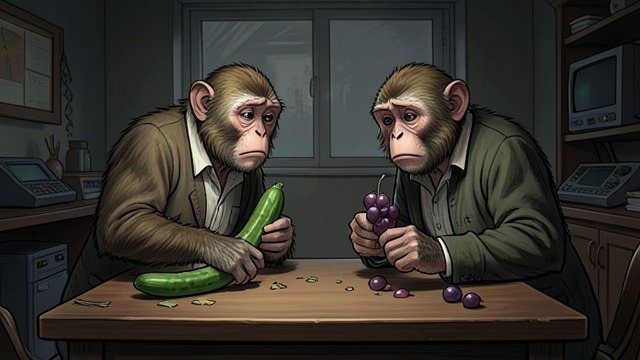
Rejecting Unequal Treatment
Human Responders
In the ultimatum game, proposers generally offer more than the strict self-interest model predicts, because responders commonly reject very small offers. Both sides understand that a perceived insult can lead to no money for either participant.
When proposers appear to have earned their position, however, responders accept lower offers more readily. Fairness is linked to what people believe someone deserves.
Unequal Rewards in Monkeys
Sarah F. Brosnan and Frans B. M. de Waal found that capuchin monkeys sometimes rejected cucumber when a partner received a grape for similar work, or no work at all.
The experiments broaden the book’s account of fairness: people and other primates can sacrifice immediate reward when the exchange feels unjust.
Trust Beyond Familiarity

Trade Among Strangers
From In-Group Reliance
Quaker businesses gained from trust and shared faith, while earlier trading networks often relied on group sanctions to discourage cheating. Such arrangements made commerce possible but confined trust largely to known communities.
Over time, contract law and business reputations helped make reliable exchange between strangers more plausible. Fixed prices and institutions that certified quality supported this shift.
Impersonal Cooperation
The book argues that modern capitalism can cultivate trust by making repeat business, reputation, and transparent exchange valuable. A buyer need not know personally who made a product to expect it to work.
Impersonal trade becomes a social achievement when institutions make it costly to deceive and worthwhile to cooperate.
Keeping Consent to Pay

The Fragile Tax Bargain
Free Riding Becomes Visible
Offshore schemes and corporate tax shelters made tax avoidance appear more common and more successful. Many Americans continued paying, but perceptions of unfairness threatened their willingness to contribute.
Taxes fund public goods that people can enjoy whether or not they personally pay. That structure creates a temptation to free ride, especially when enforcement seems weak.
Trust, Enforcement, and Reciprocity
Experiments by Ernst Fehr and Simon Gächter show that people may punish free riders even at personal cost, and that visible punishment can sustain cooperation. Tax compliance similarly depends on believing that others contribute and that evasion is detected.
The resolution is not law alone: a working system needs trust in neighbors, confidence in public institutions, and credible enforcement.
Summer 2002, after Italy’s World Cup elimination
September 2003
The ultimatum and capuchin studies discussed in 2003
The chapter 6 historical account of commerce
The late 1990s tax-evasion boom and early 2000s
